Light ions: one year on
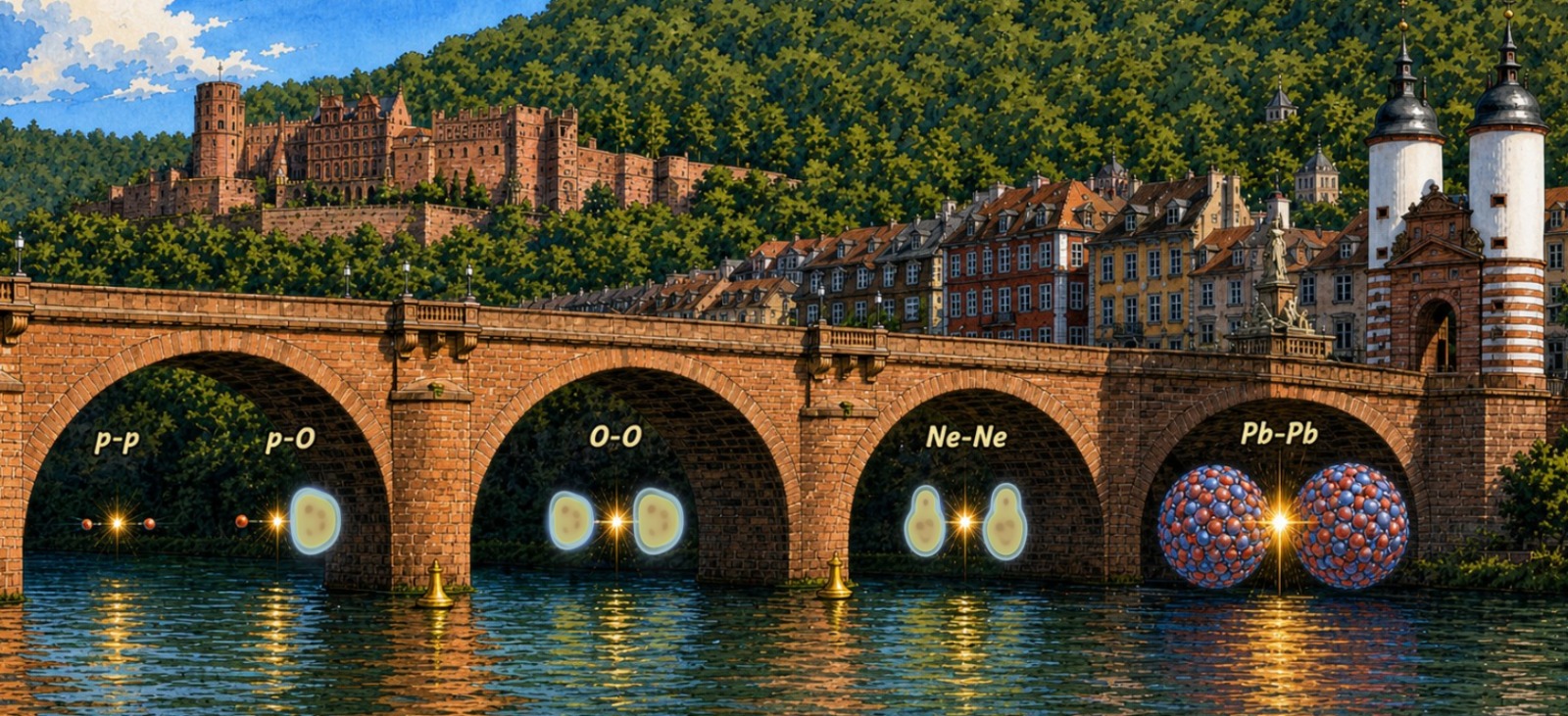
It has been just under a year since the first light-ion collisions took place at the LHC, and what a year it has been! In this post I will try to catch up with all the developments in my group.
Initial Stages in Taipei and the first evidence of energy loss in small systems
First, last September I was excited to travel to the Initial Stages conference in Taiwan, where the first results from the light-ion run were expected. The data had been collected barely two months earlier, so our experimental colleagues sacrificed their summer to deliver a hot-off-the-press set of measurements.
I was also rushing to update the baseline computations for the hadron nuclear modification factor from our original 2020 publication (Huss et al., 2021; Huss et al., 2021). The idea is simple: before you can claim to see energy loss — the hallmark of quark-gluon plasma formation — you need to know precisely what the data should look like without any energy loss. The updated “no-quenching” baseline became my first single-author publication (Mazeliauskas, 2026). Although I usually prefer working in a team, it was a thrilling experience to write a paper entirely on my own.
When the first OO data were finally shown, the charged-hadron nuclear modification factor dipped below the no-quenching baseline — exactly the direction expected if partons lose energy while traversing a tiny droplet of quark-gluon plasma. It was the first evidence of energy loss in collision systems with an average of 10 participant nucleons. Furthermore, the measurements of elliptic flow agreed beautifully with the hydrodynamic predictions, and the data even revealed the elliptic-flow enhancement in neon-neon collisions caused by the deformed shape of the neon nucleus.
These results were a game changer. Beforehand, it was by no means guaranteed that hydrodynamic models tuned on lead-lead data would remain valid in systems with only a handful of participating nucleons. The agreement is a striking confirmation of the predictive power of the framework. It also demonstrated that the modeling is now under such good control that non-trivial nuclear-structure information can be read off from the collision data — in effect, using the LHC as a femtoscale camera for the shape of nuclei. The high-quality data has energized the whole community, and new results have kept appearing throughout the year.
With a couple of months to digest the Initial Stages results, in December 2025 we organized a snap three-day workshop at CERN to take stock and to discuss the prospects for more light-ion running. Sadly, due to the passing of my father, I had to cancel my participation. My colleagues nonetheless had a very productive meeting. We also decided to follow up the CERN meeting with a full-week workshop in Heidelberg in 2026.
In February 2026, RHIC finished its quarter-of-a-century run. Its final week included a run of OO collisions, which will let the sPHENIX experiment study jets in these small systems at a collision energy of 200 GeV. Together with the LHC measurements at 5.36 TeV, this gives us a valuable handle on how the energy-loss signal evolves with collision energy.
In March 2026 I also took part for the first time in the 60th Rencontres de Moriond, in the QCD and High Energy Interactions session (Mazeliauskas, 2026). Moriond has a very long tradition; it is set deep in the Alps with the explicit goal of bringing different communities into the same room (and onto the same ski slopes). I was happy to introduce light-ion collisions to a broad audience, and it was gratifying to see multiple other contributions on light ions — a sign of how quickly the topic is moving into the mainstream.
Closing in on discovery in oxygen-oxygen collisions
The latest light-ion results appeared just this Friday from the ALICE collaboration: a measurement of the ratio of $R_\mathrm{OO}$ over $R_\mathrm{pO}^2$ (arXiv:2606.19967). I am very proud that our no-quenching calculations served as the reference in this paper.
The story behind it is a nice example of theory and experiment pushing each other forward. Back in November 2025 I met Nicolas to discuss their work on the nuclear modification factor in OO. It was clear that the experimentalists were taking up the challenge of reaching the coveted 5σ “discovery” significance for energy loss, and the single biggest obstacle was the theory uncertainty in the baseline — dominated by our imperfect knowledge of nuclear parton distribution functions (nPDFs). Nicolas and his colleagues Florian and Constantin had been working on nPDF baseline computations for a range of observables, together with clever ideas for how to make these uncertainties cancel. One particularly neat trick is to combine the OO measurement with the measured pO collisions: since both share the same oxygen nPDF, taking the ratio $R_\mathrm{OO}/R_\mathrm{pO}^2$ largely cancels the nuclear-PDF dependence and leaves the energy-loss signal exposed.
They invited me and the nPDF expert Petja to join the effort, and together we published a compendium of cold-nuclear-matter baseline predictions for light-ion collisions (Jonas et al., 2026). The $R_\mathrm{OO}/R_\mathrm{pO}^2$ ratio was one of the observables we worked through in detail — and it is exactly the one ALICE has now measured. The result just missed the formal 5σ discovery threshold, but the 4.9σ significance nevertheless leaves no doubt about the presence of significant energy loss in oxygen-oxygen collisions.

New faces in the group
The turn of the year also brought changes to my group. Adam has left for CERN TH, where he has taken up a prestigious senior research fellowship. New members have joined the group: Sergio from Santiago de Compostela as a postdoc and Ferdinando from Torino as a PhD student. Fabian, meanwhile, has secured a postdoc in Santiago de Compostela and will defend his PhD in July — my very first PhD student to do so!
Recently Lea completed her master’s thesis; Manuel has joined as a new bachelor student working with Toshali; and Q’inich has started a master’s thesis working closely with Jannis and Jürgen. For three weeks in May–June, Derek Teaney — my PhD advisor — joined my group as EMMI visiting professor for a very intensive and productive stay in Heidelberg. It was a pleasure to have him around.
New Ions @ the LHC and light ions in Heidelberg
I have also taken on a new responsibility as one of the conveners of the LPCC heavy-ion working group. The mandate of the LHC Physics Centre at CERN is to facilitate communication between the LHC experiments and the theory community.
A perfect task for LPCC HI WG presented itself thanks to the initiative of Giuliano Giacalone and Reyes Alemany-Fernandez. Giuliano, Reyes and the HI WG conveners have launched the New Ions @ LHC initiative to solicit community input on the science cases for different ion species. The response has been enthusiastic. Our goal is to assemble these cases into a white paper by 2029, in good time for the experimental collaborations to weigh them when the Run 4 schedule is decided. The OO and NeNe runs have already proved the point: even a short opportunistic run can answer qualitatively new physics questions.
Finally — and this is the development I am most excited about — in April we received funding from the GSI Extreme Matter Institute (EMMI) for a Light-Ion Collisions workshop in Heidelberg, to be held September 21–25 at the Kirchhoff Institute for Physics.
The recent campaigns — pO, OO and NeNe at the LHC, and OO at RHIC — have opened a transformative window onto the origins of collective behavior in small QCD systems and onto the system-size dependence of the quark-gluon plasma. At the same time, these high-energy collisions have turned into a novel probe of nuclear ground-state structure, with implications reaching all the way from nuclear theory to nuclear astrophysics and even to searches for neutrinoless double-beta decay. The workshop is conceived as a dedicated forum to synthesize the emerging experimental results, clarify what they mean for the field, and sharpen the scientific case for ion runs in LHC Run 4 and beyond.
I am organizing it together with a great team — Alexander Tichai, Andrea Dubla, Federica Capellino, Giuliano Giacalone, Reyes Alemany Fernandez and Wilke van der Schee — and we have assembled a wonderfully broad list of invited speakers. We now look forward to many abstract submissions for short oral presentations — see the indico page. The deadline is July 1st, so please hurry!
I am very excited to meet many colleagues and friends in Heidelberg, and I look forward to all the new developments the coming year will bring.
References
2026


2021


Enjoy Reading This Article?
Here are some more articles you might like to read next: